Tuesday, June 28, 2005

Tasmanian reborn (or not...)

Interesting story on Tasmanian today... The last speaker of a Tasmanian language died in 1905 (Wikipedia), and little material survives, so I'm not entirely confident in the historical reliablity of the newly announced reconstruction, especially since:

"There were thought to be a dozen or more Aboriginal languages in Tasmania and even more dialects. The language program has produced an amalgam of the languages."


Hmm. Do you speak European?

I'm not convinced that that "many within the Aboriginal community could speak palawa kani fluently" either. Still, it's worth a try. An interesting case of conlanging and language revitalization combining.

Thursday, June 23, 2005

Malay pronouns

And as long as I'm comparing pronouns, it seems only fair to note that not all languages have nice stable uncomplicated pronouns like Beja. Japanese is an obvious counterexample, but Prentiss Riddle and Macvaysia point out an egregious case in Malay... (noticed thanks to Language Hat.) I was especially struck by the "distinct set reserved just for addressing ethnic Chinese" - if I'm not mistaken, those are clear borrowings from Hokkien Chinese (where "I" is goá, "you" is .)

Beja and beyond

Some interesting news this week from the Beja, an ethnic group of the Red Sea coast of Sudan and Egypt. It's unclear whether this rebellion is representative of the Beja's general feelings or just a figleaf for Eritrean intervention (or both), but it's a story to watch - and an excuse to bring up a cool language.

Beja is Afro-Asiatic* - either part of Cushitic or a separate branch, depending on who you ask - and happens to be among the most obviously similar languages to Semitic and to Berber. The noun morphology is already fairly suggestive:


Beja definite articleArabic noun endingsKabyle obligatory prefix
Masculine nominative singularu:--uw-
Masculine accusative singularo--aa-
Feminine nominative singulartu:--atut-
Feminine accusative singularto--atata-


And the pronominal object suffixes add credence:

BejaArabicKabyle
me-i, -o-ni:-iyi
you-ok-ka-ik
us-on-na:-aγ
you (pl.)-okn-kum-kən


(Beja, apparently, has no third person suffixes.) However, what really clinches it is the verbal system. Beja has two principal classes of verbs: one that often takes prefixes, and one that usually just takes suffixes. In Semitic, the prefixes are used for the imperfect, and the suffixes developed from a stative (still to be seen in Akkadian) into a perfect; Berber mostly retains the prefixes, whereas only minor traces of the suffixes remain. The prefixes are especially telling:

BejaArabicKabyle
Ia-'a-
you (m.)ti- -ata-t- -ḍ
you (f.)ti- -ita- -i:t- -ḍ
hei-ya-i-
sheti-ta-t-
wen-na-n-
you (pl.)ti- -nata- -u:nat- -m
theyi- -naya- -u:na-n


while the suffixes are best exemplified in Beja in the conditional mood:


BejaArabicDahalo general non-past (Cushitic)
I-i-tu-o
you (m.)-tia-ta-to
you (f.)-tii-ti-to
he-i-a-:i
she-ti-at-to
we-ni-na:-no
you (pl.)-tina-tum-ten
they-ina-u:-en, -ammi


Just for good measure, in the prefix verbs you also have a feature found in Akkadian (among other Semitic languages) and Berber but lost in Arabic: a present tense formed by doubling the middle radical (in Berber and Akkadian) or adding n before the middle radical (in Beja). Compare:

  • Beja aktim ("I arrived") > akanti:m ("I arrive")
  • Akkadian almad ("I learned") > alammad ("I am learning")*
  • Tamasheq əlmədǎγ ("I learn", irrealis) > lammǎdǎγ ("I am learning", realis)


It's really remarkable, considering all this, that Afro-Asiatic research isn't more advanced. There are two etymological dictionaries out there, admittedly - Ehret's and Orel and Stolbova's - but, though valuable, they frequently disagree with each other, and neither has attained general acceptance.

* Some people think Afro-Asiatic is not proved. I can't think why. Omotic's membership is not entirely clear, but all the rest is just plain obvious.

* Previously misquoted forms corrected, thanks to Matthew Loran.

Tuesday, June 21, 2005

Writing Wolof (or rather وَلَفْ)


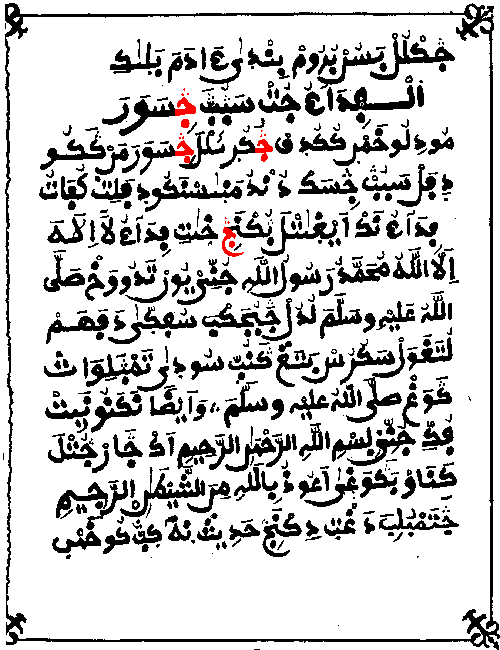
With apologies for the long hiatus in my postings, I would like to present another topic in West African writing: the surprisingly formalized tradition of writing Wolof, the main language of Senegal, in Arabic script. Wolof is also written in Latin script, I should note, which you can see copious examples of in the pedagogical materials on this Gambian Peace Corps site, but the Arabic script is much more widely known, especially in rural areas, although French is far more widely used for writing than Wolof in any script.

Myself, I only went to Dakar, so books in Wolof of any sort were relatively hard to come by. However, Arabic bookstalls, while rarer than the French ones, weren't hard to find (they had a predominantly religious focus, but a number of literary, scientific, and historical works), and, while most of their works were in Arabic, they had a couple of Wolof religious texts in a rather nice Arabic script, of which I enclose a scan. I was going to retype some, but even a cursory effort revealed serious issues. For instance, there is a Unicode letter for the common West African vowel sign that indicates short e (a dot under the letter, smaller than dots that form part of the letter) - the charts say it's 065C - but I can't find a font that will display it; and another common letter which seems to indicate ny or nj, jiim (ج) with three extra dots on top, isn't in Unicode at all. Apart from those, the main differences with standard Arabic seem to be:


  • Short e is as described previously; long e is indicated by adding an alif maqsura ى with a small alif on top (another character I can't seem to find fonts for, despite its commonness in the Qur'an; it should be 0654.)
  • p is a ba ب with three dots on top (and actually is in Unicode - 0751.)
  • A dal with three dots above (ڎ) occurs some places; I don't know how it's pronounced.
  • gaaf is a kaaf with three dots (ڭ), following longstanding Maghrebi tradition.
  • Again in the Maghrebi tradition, faa has its dot below, and qaaf has a single dot above.


PS: You can find a font that will display some of these letters at PakType; however, their selection is more adapted for Sindhi (which has the largest Arabic-based alphabet I know of) than for West Africa.

PPS: Apparently, the latest version of PakType can display all these after all; see comments...

Wednesday, June 08, 2005

R-dropping

Most English speakers are familiar with the phenomenon of r-dropping; it divides the English-speaking world into Ireland, Scotland, and most of America (where r is kept throughout), and England, Wales, Australia, New Zealand, and the American South and New England (where r is lost after vowels.) Despite this broad distribution, r-dropping somehow seems emblematic of British English, so I was naively surprised to observe it in other languages; yet the same sound-change happens to be observable in Tarifit, the Berber dialect of northeastern Morocco, and seemingly in Korandje, a Songhai language brought from Timbuktu to a northern Saharan oasis, Tabelbala, along the trade route to Sijilmasa in Morocco. Some examples:

* Tarifit ddaa, live! = Kabyle dder (here e=schwa=ə)
* Tarifit thamoath, earth = Kabyle thamurth (th=θ)
* Tarifit adhvea, pigeon = Kabyle ithvir (dh=ð, v=β)
* Korandje bia, big = Timbuktu beer(i)
* Korandje lekhba, news = Arabic al-akhbaar (kh=x)

I wonder what other cases are out there?

PS: Thank you, Language Hat, for your kind welcome!

Wednesday, June 01, 2005

Blin'ty

Leafing through a book on the early days of Rastafarianism, I came across the word "blin'ty" in an interview with someone speaking Jamaican patois. Blin'ty? Is that some kind of Russian pastry? Apparently not.

It seems that Rastas have developed some rather interesting ways of reflecting their beliefs in their speech. Usages like "I an' I" are well-known, but less widespread are avoidance terms where the opposite of a word is substituted. The people of the city, from a Rasta perspective, are "Babylon"; they don't see the truth, so why should the word "city" contain the sound of "see"? (In a Jamaican pronunciation, anyway...) Rather, they substitute the more appropriate syllable "blind"...

Thursday, May 26, 2005

N'Ko

I've recently gotten back from travelling in Mali and Senegal. At the conference I was attending in Bamako, I met several delegates from the N'Ko movement. N'Ko is an old Manding term, meaning "I say" in each of the mutually comprehensible Manding languages (principally Bambara, Maninka, Mandinka, and Dyula) and hence traditionally used as a general term to cover Manding. In 1949, a Guinean Maninka-speaking shaykh, Solomana Kanté, stung by a Lebanese claiming in the newspaper that African languages could not be written and were thus worthless, decided to start writing his language. He experimented with Arabic and Latin scripts, but found them inadequate to Maninka's tone and vowel systems; so he devised a new alphabet, N'Ko. He went on to write nearly two hundred books in the new script, including a translation of the Qur'an, textbooks of physics and history, descriptions of traditional medicine, and books of poetry; his disciples carried on the task after his death, and the script has spread surprisingly widely, mainly in Guinea and Cote d'Ivoire.

After the conference, I wandered around Bamako a bit, and randomly ran across a market stall with N'Ko writing all over it. Naturally, I went over and asked about it; it turned out to be a traditional medicine shop. All the remedies were labelled in N'Ko, and the shop's accounts (I happened to notice) were kept in N'Ko; apparently, the stallholder used Solomana Kante's works on traditional Manding medicine... In the next stall, where they were setting up a bookstore, was an N'Ko teacher. I ended up having quite a long discussion with him; the topic was interesting enough that I didn't even notice that he had 12 fingers until an hour later, although that did make the meeting more memorable.

He showed me some books in N'Ko (textbooks of maths, physics, and geography, a grammar, a philosophical work, a newspaper, and the Qur'an translation) and spoke eloquently about what a difference it made to have access to knowledge in your own language for once. He had studied algebra and geometry through highschool, in French, without understanding them; yet when he read about them in his own language, the concepts became easy. Studying in French, he argued, you became alienated from yourself and your culture as the price for your knowledge; studying in N'Ko, your knowledge fit naturally into your own identity. Despite the funding of literacy organizations, the inadequate, atonal Latin orthography for Bambara was still virtually unused, while N'Ko (he claimed implausibly) was being studied by most of Bamako. He also explained something I hadn't realized: the N'Ko movement uses a common standardized language, a literary Manding "purified" of Arabic and French borrowings, utilising the most conservative dialects, and full of agglutinatively coined neologisms for modern technical terms, thus creating a dialect that they felt could compete with French in all usages rather than being restricted to low registers and simple topics.

I was impressed. It looks to me like N'Ko enjoys one massive advantage over Latin: not the tones, nor even the books (though they help!), but the evangelical dedication it inspires in its devotees, without which a literacy program in an unwritten language is unlikely to overcome the obstacles it faces.